

Our CODIS follow-up systems require leadership and management to be effective
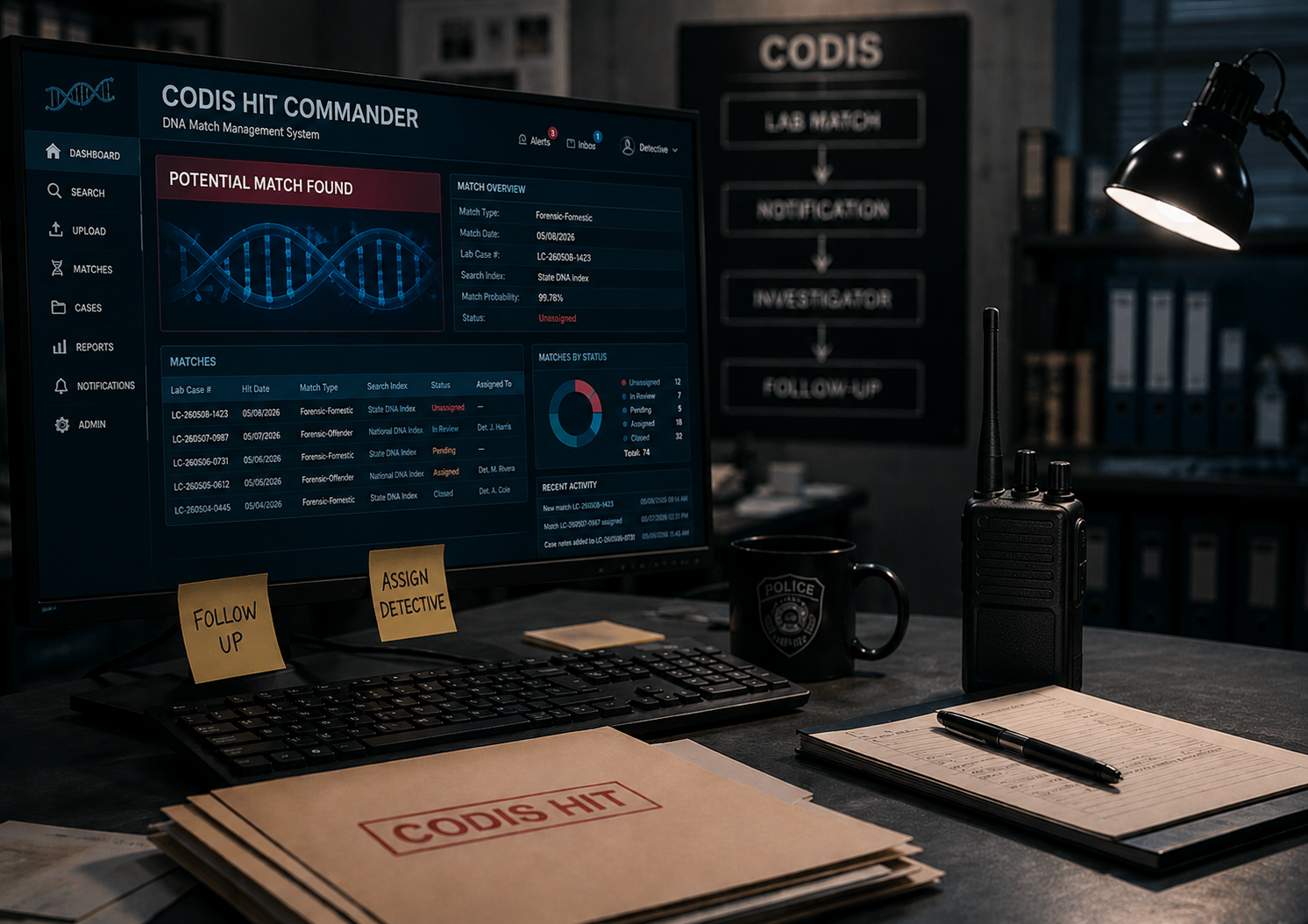
Effective CODIS hit tracking requires documented ownership, supervisory oversight, and a reliable follow-up process; without them, an agency may lose a valuable investigative lead before anyone acts on it.
Key takeaways:
- A CODIS hit is an investigative lead, not proof of guilt: Investigators must confirm and evaluate a DNA database association and support it through additional investigation before it can establish probable cause or support prosecution.
- Extensive work occurs before a notification reaches a detective: Crime scene personnel, evidence technicians, forensic scientists and laboratory administrators may spend hundreds of hours collecting, preserving, analyzing and comparing biological evidence.
- The laboratory-to-investigator handoff may create the greatest vulnerability: Agencies can lose a notification when email or disconnected administrative processes replace centralized tracking, documented assignment and supervisory review.
- CODIS follow-up is primarily a management and workflow issue: Investigators face competing cases, transfers, promotions and retirements. Agencies must build systems that preserve continuity rather than rely on individual memory or personal filing practices.
- Every agency should account for every CODIS notification: Police executives should know how many notifications their agency has received, which investigator accepted each one, what action personnel took, and which leads remain unresolved.
For many years, I had responsibility for each division in our investigations bureau and thoroughly understand the demands that officers, investigators, supervisors, and police executives face. Today, however, I view the criminal justice system from a different and sometimes uncomfortable perspective. As a victim advocate, I now represent families who have waited 20, 30, and even 40 years or more for answers in their loved ones’ unsolved homicide investigations.
It is a perspective I never expected to have. During my career, I viewed investigative challenges from inside the organization, where staffing, evidentiary limitations, laboratory delays, and competing cases influence operational decisions. Families experience those investigations from the outside. They do not see reassignments, laboratory queues, or the growing number of new cases on a detective’s desk. They experience birthdays, anniversaries, and years without answers.
The management gap behind CODIS hits
Recently, a whistleblower employed by a medium-sized municipal law enforcement agency provided me with an internal audit documenting failure to follow up on over 400 CODIS hits. The sheer volume of this number should be disturbing to every reader, but I would implore you to conduct your own audit and take any necessary corrective action.
According to the document, investigators apparently had not acted upon more than 400 investigative leads. These gaps exist at many more agencies than we are willing to admit.
I identified the same follow-through gap in my previous article, “The DNA failure that’s letting predators slip through the cracks,” which discussed the issue in the context of collecting lawfully owed DNA. I noted that a CODIS hit represents a substantial investment in crime-scene processing, laboratory analysis, and investigative effort. Yet, an agency can lose the value of that work when it lacks a dependable mechanism to assign and pursue the lead. [1]
400 ignored CODIS notifications do not mean investigators would have solved 400 crimes. A CODIS hit does not prove that a person committed a crime, nor does it replace the need for further investigation. Investigators must confirm and evaluate the lead in light of the facts and evidence of the case. Some associations will have innocent explanations, and some investigations will lack enough corroborating evidence to establish probable cause.
That distinction extends beyond CODIS to any critical investigative lead. A profound difference separates a lead that investigators properly pursued and ultimately exhausted from one that no one assigned or documented and that the agency allowed to disappear inside its administrative process. The first reflects an investigative outcome. The second reflects a breakdown in management and workflow.
What happens before a CODIS hit reaches an investigator?
The Combined DNA Index System (CODIS) allows participating laboratories to compare qualifying DNA profiles electronically. Depending upon the indexes involved, a search can associate biological evidence from one crime with evidence from another or connect a forensic profile with a qualifying offender or arrestee profile. [2]
The process begins long before a notification reaches a detective. Personnel must recognize, document, collect, package, and preserve biological evidence, and an agency must decide whether to submit it for testing. At the forensic laboratory, scientists attempt to develop a qualifying DNA profile for comparison.
By the time a notification reaches an investigator, numerous professionals and public funds have contributed to the result. Behind that work is a victim and, in a cold case, a family that may have waited decades for a new investigative opportunity.
When the laboratory transmits the notification to the investigating agency, DNA has done its job. The laboratory has done its job. CODIS has done what its designers intended. The receiving law enforcement agency controls the next step.
Where can the process break down?
The administrative handoff from the laboratory to the investigator may create the weakest point in an otherwise highly regulated forensic process.
A laboratory may transmit a notification by email, letter, secure portal, or another approved communication channel. Depending upon local policy, the laboratory might send that information directly to a detective, a unit supervisor, an agency CODIS liaison, an evidence employee, or a general investigations email address. Once the notification leaves the laboratory, the agency’s internal procedures largely determine the quality and timeliness of the response.
A reliable process should immediately answer several questions. Who received the notification? When did that person acknowledge it? Which investigator and supervisor took responsibility? What investigative actions did personnel complete? Did anyone consult the prosecutor? If investigators could not pursue the lead, did they document the reason?
Without a centralized, auditable workflow, personnel may have to search individual email accounts, locate spreadsheets maintained by separate units, review handwritten notes, or rely on the memory of an employee who may no longer work for the agency.
Investigators retire, are promoted, transfer, and take extended leave. Supervisors change assignments. Agencies reorganize units, deactivate email accounts, and store older case files in several physical and electronic locations.
These events are not unusual. They are predictable components of police administration. Agencies should therefore design procedures that preserve investigative continuity when personnel, priorities, and organizational structures change.
Why this is not an attack on investigators
It would be easy to characterize an unaddressed CODIS lead as evidence that an individual detective did not care or failed to perform an assigned duty. In many cases, that conclusion would be both inaccurate and unfair.
Investigators routinely carry demanding caseloads while responding to new homicides, shootings, sexual assaults, robberies, missing persons, and other urgent investigations. An agency may assign a cold case as a collateral responsibility to a detective whose primary workload already consumes nearly every available hour.
The problem is not necessarily a lack of dedication. The problem is relying upon dedication without providing a dependable organizational system.
Effective organizations do not depend entirely upon the memory, availability, or personal filing practices of individual employees. They establish procedures that document responsibility, preserve continuity, and notify supervisors when personnel have not completed required actions.
Police agencies would not accept an evidence management system that allowed someone to remove a firearm, blood sample, or sexual assault kit from storage without documenting who possessed it and where it went. Agencies should apply the same principle to a DNA-generated investigative lead. The organization should know when it received the lead, who accepted responsibility, what action occurred, and how investigators resolved the matter.
Accountability does not always mean discipline. In this context, accountability means visibility. It permits supervisors to determine whether personnel actively pursue a lead, delay it, leave it unassigned, transfer it, or await action by another organization. It also protects investigators by documenting workloads, identifying resource shortages and showing when urgent competing priorities have prevented immediate follow-up.
A reliable tracking system does not simply expose inaction. It gives police managers the information necessary to assign personnel, remove barriers, and correct the conditions that create delays.
What happens when an agency delays a lead?
An unaddressed CODIS notification is more than an unfinished administrative task. Delay can reduce the value of an otherwise promising investigative opportunity.
Witnesses relocate or die. Memories deteriorate. Retention schedules cause agencies to destroy records. Personnel misplace physical evidence or struggle to locate it. Investigators familiar with the original case retire. A suspect may die before investigators can obtain a confirmation sample or evaluate the significance of the DNA association.
Research examining unsubmitted sexual assault kits in Houston found obstacles including expired statutes of limitation, difficulty locating victims, and victims who did not wish to participate. The research nevertheless demonstrates that DNA testing can create a new investigative opportunity requiring coordinated action by investigators, prosecutors, and victim-service professionals. [3]
Delay can also affect cases beyond the originating jurisdiction. A forensic profile may connect crimes committed in different cities, counties, or states. When one agency fails to investigate or communicate the significance of a CODIS association, it may deprive another jurisdiction of information that could identify a serial offender.
In the most serious circumstances, timely follow-up might have identified an offender who instead remained free to commit additional crimes.
The audit I reviewed raises a question that extends beyond a single police department: If one large agency identified hundreds of apparently unaddressed investigative leads, how many other agencies may have the same vulnerability but have never conducted an audit?
Is CODIS hit tracking a new idea?
California developed the CODIS Hit Outcome Project (CHOP) to transmit CODIS-hit information and track the progress and outcome of associated cases. After personnel entered a hit and the crime laboratory supplied the initial case information, CHOP notified the responsible law enforcement agency and provided fields for investigators and prosecutors to document investigative activity, arrests, charging decisions, and case dispositions. In practice, however, agencies did not use those outcome-tracking functions reliably.
Auditing 417 CODIS hits generated through the system between April 2015 and March 2018 revealed CHOP contained no case-outcome information for 278 of those hits (67%). Agencies reported whether they were investigating the associated case for only 114 hits (27%) and documented whether a hit caused them to open or reopen an investigation in only 84 instances (20%). The auditor also found missing, inaccurate, and outdated entries and attributed the deficiencies to inconsistent participation, inadequate training and guidance, and the Department of Justice’s failure to routinely identify and follow up with agencies that did not update their records. [4]
Tracking the evidence is not the same as tracking the lead
California separately developed the Sexual Assault Forensic Evidence Tracking database to track the collection, submission, and processing of sexual-assault evidence kits. SAFE-T and CHOP illustrate two different but connected responsibilities: tracking the physical evidence through laboratory processing and tracking the investigative lead produced by that evidence. California’s experience also demonstrates that creating a statewide database does not ensure agencies will use it consistently. Without mandatory reporting, clearly assigned responsibility, recurring reminders, supervisory review and compliance monitoring, a tracking system may confirm that a laboratory generated and transmitted a hit without establishing that an agency assigned, investigated or resolved it. [5]
At its core, the issue is one of management. The broader lesson is that generating and transmitting a forensic result does not complete the process. A laboratory can notify an agency of a potential association. However, the investigating organization must acknowledge the notification, assign a lead, document each investigative step, establish follow-up deadlines, and record the final disposition. A system that records the hit but lacks reliable outcome data measures laboratory productivity—not investigative accountability.
What should a CODIS hit tracking process include?
A chief, sheriff, or investigations commander should be able to request a report identifying every CODIS notification the agency received, its case number, date received, assigned investigator and supervisor, most recent documented action, and current status.
The process should flag unassigned or overdue notifications and formally reassign responsibility when an investigator retires, promotes, or transfers.
At a minimum, a CODIS hit tracking process should:
- Record every incoming notification in a centralized and searchable system.
- Assign the lead to a named investigator and supervisor.
- Document when personnel received and acknowledged the notification.
- Establish follow-up dates and investigative milestones.
- Generate alerts when personnel fail to document required actions.
- Preserve continuity during transfers, promotions, retirements and unit reorganizations.
- Maintain a complete audit trail of assignments, status changes and investigative actions.
- Provide executives with reports on outstanding, delayed and completed leads.
An agency may meet these requirements with a carefully designed database or a module within an existing records or case management system. A larger department may require a dedicated application to automate notifications, escalate overdue tasks, and generate performance reports.
The objective is not technology for technology’s sake, nor does this article argue that software can replace police work. Technology cannot interview witnesses, assess credibility, establish probable cause, or present a case to a prosecutor. It can, however, prevent a scientifically generated investigative opportunity from becoming invisible after it enters the police department.
What should police executives do now?
Police leaders routinely audit evidence rooms, use-of-force reports, pursuits, training records, citizen complaints and financial controls. CODIS hit management deserves comparable executive attention because it involves public safety, organizational risk, the expenditure of public funds and the legitimate expectations of victims.
The first step does not require a major technology purchase or legislative change. It begins with a direct question: How many CODIS notifications has our agency received, and what happened to each one?
If answering that question requires personnel to search individual email accounts, contact retired detectives, or reconstruct years of activity from disconnected spreadsheets, the agency has identified a vulnerability that leaders should correct.
To start, have your partner laboratory provide a list of CODIS hit notifications communicated without a corresponding response. Many laboratories have Lab Information Management Systems (LIMS) with this capability. An initial audit should compare laboratory notifications with investigative records and determine whether personnel acknowledged, assigned, and resolved every lead. Agencies should then establish a written policy that identifies who receives CODIS notifications, who assigns them, which actions personnel must document, when supervisors must review the work, and how managers escalate unresolved matters.
Managers must also examine whether investigators have the resources necessary to complete the work. Creating an automated alert accomplishes little when the assigned detective already carries an unmanageable caseload. Agencies should therefore pair tracking with realistic workload assessments, clear priorities, and access to forensic and prosecutorial support.
Conclusion
I remain a committed supporter of law enforcement. I know that most investigators are doing the best they can under difficult circumstances, and I recognize that police executives must constantly balance urgent public safety needs against limited staffing and funding. That reality does not weaken the case for stronger systems. It makes those systems more necessary.
DNA technology continues to advance, and governments continue to invest in laboratory capacity, database expansion, sexual assault kit testing and backlog reduction. Those investments will generate additional investigative leads, and agencies must prepare to manage them.
DNA is not failing us. The scientists are not failing us, and in most cases, neither are the detectives. The vulnerability lies in the gap between the laboratory result and the documented investigative action.
When an agency generates, receives, and then allows a CODIS lead to disappear, the failure belongs to the system it created—or failed to create.
Every critical investigative lead should have an owner. Every owner should have supervisory support and accountability. Personnel should document every action, and every victim deserves to know that when forensic science provides an investigative opportunity, someone follows it wherever the evidence leads.
References
1. Levatino, T. (2025, June 19). The DNA failure that’s letting predators slip through the cracks.
2. Federal Bureau of Investigation. (n.d.). CODIS and NDIS fact sheet.
3. National Institute of Justice. (2016). Unsubmitted sexual assault kits in Houston, Texas.
4. California State Auditor. (2019). Follow-up—Sexual assault evidence kits
5. California Department of Justice. (2020). Sexual Assault Forensic Evidence Tracking Database.