

Lorraine Bieze: An Unsolved 1982 DuPage County Homicide
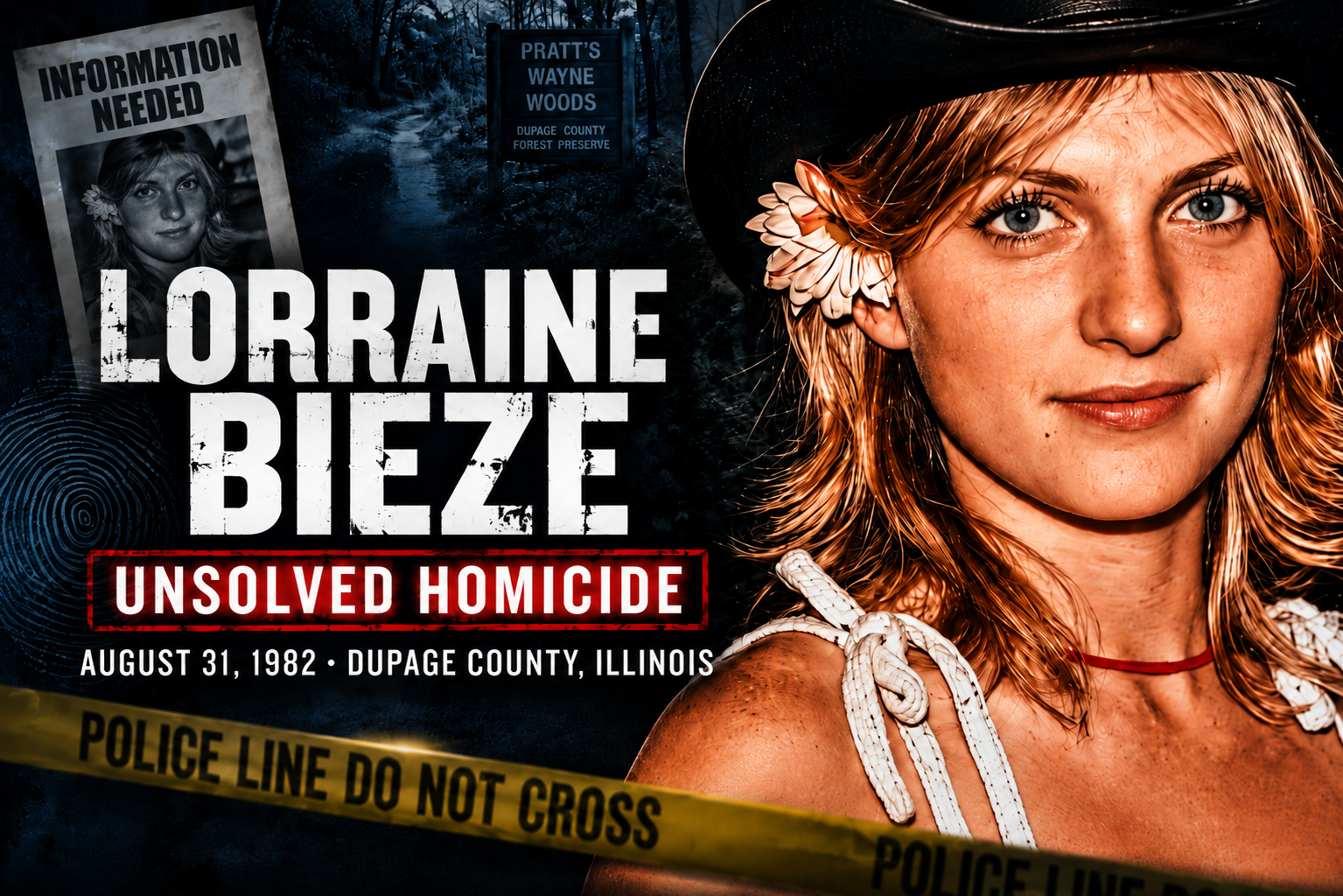
On August 30, 1982, 21-year-old Lorraine Frances Bieze disappeared while walking home from work in Mount Prospect, Illinois. The following day, her body was discovered in Pratt’s Wayne Woods in DuPage County. More than four decades later, Lorraine’s murder remains unsolved.
Time has changed nearly everything about the way investigators approach a homicide. DNA technologies unavailable in 1982 can now recover investigative information from extraordinarily small or challenging biological samples. Digital records can connect people, places, vehicles, events, and relationships that once existed only in separate paper files. Forensic investigative genetic genealogy has demonstrated that even cases considered unsolvable for decades can sometimes yield new leads.
But technology alone does not solve a cold case. Someone must reconstruct the investigation, determine what was done, identify what remains unresolved, establish what evidence still exists, and ask what today’s investigative and forensic capabilities can reveal that earlier generations of investigators could not. That is the purpose of our independent investigation into Lorraine’s murder.
The Disappearance
On Monday, August 30, 1982, Lorraine was working at the Snuggery Saloon in Mount Prospect, Illinois. After finishing her lunch shift, she began walking home. She never arrived. Lorraine’s disappearance quickly became something far more serious than a missing-person investigation. The following day, August 31, her body was discovered in a wooded area near railroad tracks in Pratt’s Wayne Woods. Lorraine had been murdered.
The crime began an investigation that would span more than four decades and involve numerous investigators, interviews, tips, potential suspects, forensic examinations, evidence submissions, and laboratory analyses. Yet no one has been held accountable for Lorraine’s death.
A Case That Has Outlived Generations of Investigators
One of the greatest challenges facing any cold-case investigation is time. Investigators retire. Witnesses move or die. Memories fade. Agencies change personnel, procedures, record systems, and technology. Physical evidence may be transferred, tested, partially consumed, repackaged, or documented differently as forensic practices evolve. Reports generated decades apart may never have been examined together. At the same time, each new generation of investigators can inherit the assumptions and theories developed by those who came before them.
Reviewing a cold case is not necessarily the same as reinvestigating one. A comprehensive reinvestigation requires returning to the underlying information and evidence and asking fundamental questions without assuming that previous conclusions were correct: Who knew Lorraine and her routines? Who was in the area when she disappeared? What vehicles or unusual activity were reported? Which individuals were investigated—and why? Which individuals were eliminated—and upon what evidence? What physical evidence was recovered? What was tested? What remains available? What was never tested?
And perhaps most importantly: What can be done today that investigators in 1982 could not possibly have done?
Reconstructing the Investigation
The International Association of Technology Advocates (IATA) is conducting an independent investigation into Lorraine’s murder. This effort is separate from the official law-enforcement investigation. Its purpose is to apply contemporary investigative methodology, technology, forensic knowledge, and analytical tools to information developed during more than four decades of investigation.
The objective is not simply to accumulate documents. It is to reconstruct the investigation. Records spanning decades must be organized chronologically and connected to the people, evidence, locations, investigative leads, forensic examinations, tips, and decisions they describe. That process can reveal something extraordinarily difficult to recognize when reviewing thousands of individual pages: patterns and relationships.
A name appearing in one report may become significant when connected to an interview conducted years later. A laboratory result may take on new importance when compared with an evidence inventory. A location mentioned by one witness may intersect with another person’s movements. An investigative lead considered insignificant decades ago may deserve renewed attention when viewed alongside information unavailable at the time. Cold cases are not always solved by a single dramatic discovery; sometimes they are solved by recognizing connections that were previously invisible.
Using XigentIQ to Examine Lorraine’s Case
Lorraine’s investigation is being organized and analyzed using XigentIQ (XIQ), an investigative intelligence platform designed for complex and long-term investigations. Traditional case files often separate reports, people, evidence, laboratory results, tips, timelines, photographs, locations, and investigative leads into different records or systems. XIQ approaches the investigation differently by allowing those elements to be structured as parts of the same investigative environment so relationships among them can be identified and examined.
For Lorraine’s case, decades of information can be organized around:
- People and investigative roles
- Dates, events, and timelines
- Physical and biological evidence
- Laboratory examinations and forensic results
- Locations and geographic relationships
- Witnesses, persons of interest, and potential suspects
- Investigative tips and leads
- Vehicles and other identifiers
- Historical records and supplemental reports
- Relationships among people, places, evidence, and events
- Unresolved questions and investigative tasks
The purpose is not to ask artificial intelligence to “solve” Lorraine’s murder. XIQ is intended to help investigators organize complex information, identify relationships, recognize inconsistencies, develop questions, and determine where additional investigation may be warranted. Technology supports the investigation. Human judgment remains essential.
The Forensic Evidence Deserves Another Look
Perhaps no aspect of criminal investigation has changed more dramatically since 1982 than forensic DNA analysis. DNA profiling was not available to the investigators who originally examined Lorraine’s murder. Even forensic examinations conducted many years later were necessarily constrained by the technology, instrumentation, analytical methods, and databases available at the time.
Today’s forensic laboratories have capabilities that can sometimes obtain useful information from evidence that previously produced limited or inconclusive results. Depending upon the nature, condition, quantity, and availability of remaining evidence, contemporary examination may include advanced STR and Y-chromosome analysis, improved DNA recovery and interpretation methods, SNP analysis, and potentially forensic investigative genetic genealogy (FIGG). Genetic genealogy can use DNA profiles and voluntarily contributed genealogy databases to identify biological relationships that may generate investigative leads, including circumstances in which the unidentified person of interest never personally submitted a DNA sample.
That makes the preservation, inventory, and careful reassessment of remaining evidence critically important. The question should no longer simply be, “Was this evidence tested?” The better question is, “What could this evidence tell us if it were examined using the most appropriate technology available today?” Those are very different questions.
Following the Evidence Wherever It Leads
Lorraine’s case has accumulated theories and potential suspects during more than forty years of investigation. Those theories deserve examination—but theories cannot become substitutes for evidence. A meaningful cold-case investigation must be willing to challenge both old assumptions and new ones. A compelling suspect or theory should withstand comparison against timelines, geography, witness accounts, known behavior, opportunity, documentary evidence, physical evidence, and—where available—forensic DNA.
If the evidence supports a theory, the theory becomes stronger. If the evidence contradicts it, investigators must be willing to reconsider it. The objective of this investigation is not to prove that a particular theory or suspect is correct. The objective is to determine what happened to Lorraine and identify the person responsible for her murder.
Why Lorraine’s Case May Still Be Solvable
More than four decades have passed since Lorraine was murdered. That passage of time creates enormous investigative challenges, but it also creates opportunities. Investigators today possess capabilities that would have been unimaginable in 1982. Modern forensic testing can revisit biological evidence. Genetic genealogy can generate entirely new investigative leads. Digitized public records can help reconstruct historical addresses and associations. Geographic analysis can identify relationships among people, crimes, and locations. Historical newspapers and archives can be searched rapidly. Large collections of investigative records can be indexed, cross-referenced, and analyzed in ways that once required years of manual work.
Most importantly, information that once existed in isolation can now be examined collectively. None of these capabilities guarantees that Lorraine’s murder will be solved, but they provide compelling reasons not to stop trying.
Lorraine Is More Than a Case File
Cold cases can eventually become numbers: a case number, an evidence number, a laboratory number, a date, or simply the number of years that have passed. Lorraine was not a number. She was 21 years old. She had a family, friends, coworkers, relationships, routines, plans, and an entire life ahead of her.
Someone took that life. The passage of time does not diminish the seriousness of that act, nor does it diminish the importance of determining who was responsible. Lorraine’s case is not forgotten. The investigation continues.
Do You Know Something?
Someone may possess information concerning Lorraine’s disappearance or murder without realizing its significance. It could be a remembered conversation, a vehicle, a person seen in an unusual place, something someone said years later, an association investigators may never have discovered, or a detail that seemed insignificant in 1982 but takes on new meaning when combined with information available today.
You do not need to decide whether what you remember is important. Investigators can make that determination. If you have information concerning Lorraine’s disappearance or murder, we encourage you to provide it to the appropriate law-enforcement authorities. You may also submit information to IATA for consideration as part of our independent investigation.
Even after more than four decades, one piece of information could matter.