

Theone Davis: An Unsolved 1971 Huntington Park Homicide
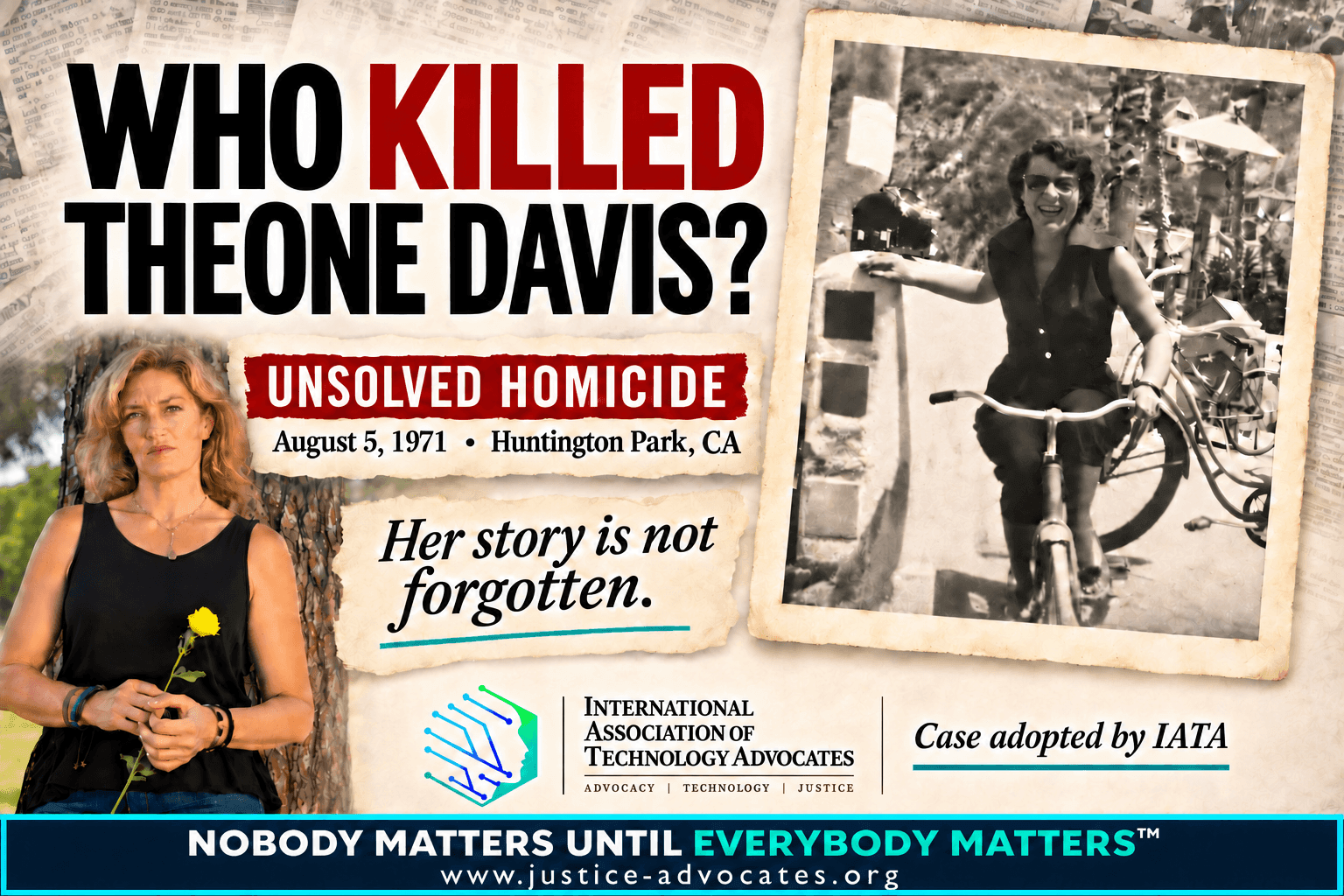
On August 5, 1971, 64-year-old Sadie “Theone” Lindgren Davis was preparing to welcome friends into her Huntington Park, California, home for an evening of bridge. She spoke with loved ones, tended her yard, and went shopping. By early evening, her husband had returned home to find her fatally injured in their bedroom.
Fifty-five years later, her murder remains unsolved.
The International Association of Technology Advocates (IATA) has adopted Theone’s case to support her family’s search for answers. Working with her granddaughter, Janelle Theone Frese, IATA is bringing investigative experience, forensic knowledge, and the XigentIQ investigative intelligence platform to an independent examination of the available information.
The work begins with understanding Theone’s life, reconstructing the events surrounding her death, and determining which questions remain unanswered.
The Murder
Thursday, August 5, began with preparations for a gathering. Theone and her husband, Herman Theodore “Ted” Davis, were expecting friends that evening. Their gardener worked at the property, and Theone spoke with friends about arrangements for the party.
According to the family’s case synopsis, she left home around midday to shop. Witness accounts describe her at or near the residence later that afternoon, including a teenage neighbor who reported speaking with her while she watered the yard shortly before 3:00 p.m.
Other accounts raised questions about activity around the home. One witness reported seeing an unidentified man inside the kitchen during the afternoon. Other witnesses described vehicles parked nearby. Establishing the reliability, timing, and investigative disposition of those observations remains important to reconstructing the day.
At approximately 5:30 p.m., Ted returned home and found Theone unresponsive. He attempted to help her and contacted the family physician. Huntington Park police responded, and the Los Angeles County Sheriff’s Department was called to assist.
The coroner’s findings, as summarized in the source document, identified a gunshot wound to the back of the head and documented additional injuries from beating and strangulation.
An evening intended for friends became the beginning of a family’s decades-long search for answers.
A Case That Has Outlived Generations of Investigators
Theone’s murder was initially investigated by the Huntington Park Police Department with assistance from the Los Angeles County Sheriff’s Department Homicide Bureau. The investigation produced witness interviews, crime-scene documentation, physical evidence, and inquiries into possible suspects and motives.
Over the following decades, investigators changed and forensic capabilities advanced. The family continued seeking information about the evidence, subsequent testing, and the direction of the investigation.
A case this old requires careful attention to how information developed over time. An original observation may differ from a later recollection. A family account may raise a question that an investigative report does not resolve. A reported evidence submission may lack an accompanying laboratory result in the records available to the family.
Those gaps must be identified and documented before conclusions can be drawn.
Reconstructing the Investigation
IATA’s independent review supports Theone’s family and is separate from the official law-enforcement investigation.
The family’s synopsis provides a starting point: a detailed account of Theone’s background, reported witness observations, evidence collection, investigative activity, and requests for further examination. Wherever possible, that information must be compared with the underlying reports, photographs, laboratory records, and other original documentation.
The review will focus on practical questions. Which sightings can be corroborated? How closely can Theone’s movements be established? What became of the unidentified people and vehicles described by witnesses? Which leads were pursued, and what supported their resolution?
Forensic questions are equally important. What evidence was collected? What remains preserved? Which examinations were completed, and what did they establish?
Each answer helps determine the next useful step.
Using XigentIQ to Examine Theone’s Case
XigentIQ (XIQ) provides a way to organize the available material and examine connections across a lengthy investigation.
For Theone’s case, that work includes structuring information around:
- Theone’s activities and reported sightings on August 5, 1971.
- Witness accounts, their sources, and differences between them.
- People, addresses, vehicles, and relevant associations.
- Evidence inventories, submissions, and documented testing.
- Historical reports, correspondence, and newspaper coverage.
- Possible comparisons with other unsolved crimes.
- Outstanding questions and follow-up tasks.
Keeping information connected to its source helps reviewers distinguish a documented observation from an interpretation or an unverified lead. It also makes missing records and conflicting accounts easier to identify.
Investigative judgment remains central. Any lead developed through the platform requires evaluation and corroboration.
The Forensic Evidence Deserves Another Look
The family’s research files describe the collection of hair samples, blood or suspected bloodstains, a stained cloth, scissors, and other items from the residence. It also references fingernail clippings reportedly located for testing years later.
These descriptions establish questions for an evidence review. They do not establish whose biological material was recovered or whether every listed item remains available.
DNA analysis was still decades away and later forensic submissions, but were attempted, including testing associated with fingernail evidence in 2017 and additional evidence in 2021. According to the family, the results have not been shared with them.
A useful next step is to establish a complete testing history: the items submitted, examinations requested, results obtained, and material retained for possible further analysis.
The family has requested consideration of forensic investigative genetic genealogy. Whether that approach is suitable must be determined through qualified review of the available evidence and laboratory findings.
Following the Evidence Wherever It Leads
Theone’s case has generated several theories. The family’s synopsis also identifies other 1971 homicides in southeastern Los Angeles County that may warrant comparison, including cases in Bellflower, Long Beach, and Downey.
Those proposed connections deserve examination against original records. Similarities in timing, victim characteristics, injuries, or reported circumstances can guide questions, but they do not establish a common offender.
A meaningful comparison must examine differences as carefully as similarities. It must also establish what investigators previously compared and whether any forensic findings support or contradict a connection.
The same discipline applies to individual suspects and persons of interest. A name appearing in a report or family research file is a lead to evaluate. Responsibility must be established through evidence.
IATA’s objective is to help clarify what happened to Theone and identify investigative opportunities supported by the record.
Why Theone’s Case Still Deserves Investigation
Huntington Park Police Department had original jurisdiction, but at the time lacked a formalized homicide investigation unit, and the case handled by the Los Angeles County Sheriff’s Department. Initially, there were substantial original investigative activity, collected physical evidence, later testing, and a family that has preserved information across generations.
Together, those materials provide a foundation for further review.
Some questions may be answered by the sheriff’s allowing an independent review of existing report. Others may require clarification from the investigating agency, a laboratory consultation, a new interview, or comparison with other cases.
The age of the investigation makes this work difficult. It also makes preserving the remaining information urgent. Family members and witnesses hold knowledge that may never have been fully recorded.
No outcome can be promised. There is still work worth doing.
Theone Is More Than a Case File
Theone was a mother, grandmother, great-grandmother, musician, and active member of her community.
Born in Salt Lake City, she moved to Los Angeles as a young woman. Her family describes a talented performer who played piano, viola, and ukulele, sang in theatrical productions, and appeared on radio broadcasts.
She contributed to the Community Christian Church of Huntington Park, including designing stained-glass windows. Her grandchildren remember her warmth, humor, intelligence, and playful spirit.
She and Ted had purchased a vacation property in Washington near family and were looking forward to spending more time there.
Her granddaughter describes her as “an absolute treasure, adored by her family and beloved by her community and friends.”
That is the person at the center of this investigation—and the life her family continues to honor.
Do You Know Something?
Information about Theone’s murder may still exist in a personal recollection, an old photograph, correspondence, or records retained by someone connected to the original investigation.
You may remember activity near her Huntington Park home on August 5, 1971, a conversation about her death, or a detail that seemed unimportant at the time.
Please share information with the investigating authorities. The family’s synopsis lists the Los Angeles County Sheriff’s Department Homicide Bureau, Unsolved Unit, at (323) 890-5500, referencing case number 071-13062-2010-010.
You may also contact IATA at info@justice-advocates.org for consideration as part of our independent review, or submit a tip on our contact page: Contact Us | Case Support for IATA
Source: Case synopsis prepared by Janelle Theone Frese, granddaughter of Sadie “Theone” Lindgren Davis, provided to IATA in 2026. Investigative details and reported testing history summarized above are drawn from that document.
NOBODY MATTERS UNTIL EVERYBODY MATTERS™